No Longer a Secret: Why London Professionals Can't Stop Coming Back to Polzeath
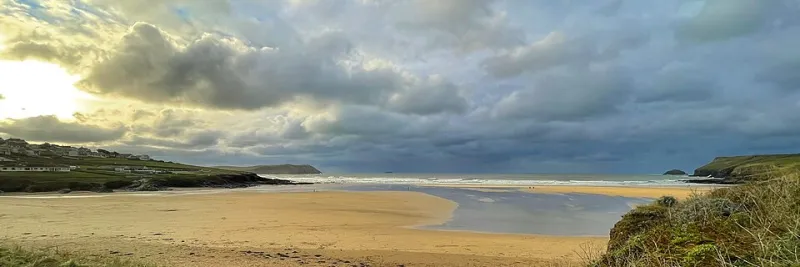
Photo: Paul Smith (Sootyskye), CC BY-SA 4.0, via Wikimedia Commons
There's a moment on the A39, somewhere past Wadebridge, when the air changes. You notice it even with the windows up — something saltier, wilder, less managed. For thousands of professionals making the trek down from London every Bank Holiday weekend, that moment has become something close to sacred. Polzeath is no longer just a beach. For a particular kind of city dweller, it's practically a second religion.
The numbers tell part of the story. Cornwall as a whole saw domestic visitor spending surge dramatically following the pandemic, and Polzeath — already a firm favourite among the surfing set — found itself at the epicentre of something it hadn't entirely asked for. Estate agents in Rock and Wadebridge will tell you, quietly, that enquiries from London postcodes never really dipped back to pre-2020 levels. The village didn't just bounce back. It transformed.
The Pull Factor: What Makes Polzeath Different
Ask anyone who makes the pilgrimage regularly and they'll struggle to give you one clean answer. Part of it is the beach itself — that broad, north-facing arc of sand that catches Atlantic swells in a way that feels genuinely dramatic without being terrifying. Part of it is the village's compactness: you can walk from a decent flat white to the waterline in under four minutes. And part of it, if people are being honest, is the social texture of the place.
Polzeath has never quite been Padstow — never quite as polished, never quite as self-consciously foodie. It retained something scruffier, more democratic in feel, even as property prices told a different story. That paradox is precisely what draws a certain type of professional. They want the wildness without the inconvenience. The authenticity without actually having to rough it.
Compare it to, say, Croyde in Devon or Fistral in Newquay and Polzeath wins on atmosphere almost every time. It's smaller, more navigable, and — crucially — it still feels like somewhere rather than a brand. For people who spend their weeks in meetings about brand strategy, that distinction matters enormously.
The Remote Work Revolution and What It Actually Changed
The laptop-on-the-kitchen-table brigade didn't invent Polzeath's appeal, but they did fundamentally alter its rhythms. Where the village once emptied out by Sunday evening, you now find a significant contingent still there on Tuesday afternoon, working from rental cottages with unreliable broadband and an excellent view of the headland.
This shift from weekend visitor to mid-week resident — even temporarily — has had knock-on effects that locals feel acutely. Parking pressure that once peaked on Saturday mornings now builds across the whole week in summer. The village shop, the café, the surf hire shack: all of them face a demand profile that's harder to staff and plan around. Businesses that built their models around a tight seasonal rush are recalibrating for something more unpredictable.
For some local business owners, this is unambiguously good news. Longer stays mean more spending, and mid-week trade that simply didn't exist before. For others — particularly those relying on seasonal, part-time staff from the local area — the extended pressure without a clear off-season is quietly exhausting.
The Tension Beneath the Tide Line
It would be dishonest to write about Polzeath's new chapter without acknowledging the friction. It's not dramatic — there are no protest signs, no organised campaigns, nothing that would make the national news. But it's real, and anyone who spends enough time talking to people who've lived here for decades will encounter it.
The core of it is simple: houses that locals might have aspired to own are being purchased as second homes or holiday lets by people for whom the price, while significant, is not the determining factor. The village's permanent population is thinning. Schools in the wider area see rolls fluctuate. Pubs that once served the community year-round now calibrate their entire offering around the summer influx.
There's also a subtler social dimension. The newcomers — weekend visitors, second-home owners, long-stay remote workers — tend to move in established social networks that don't naturally intersect with local ones. They recommend the same restaurants to each other, rent from the same handful of property managers, and can spend a fortnight in Polzeath without meaningfully meeting anyone who actually lives there full-time. Whether that's a problem depends on who you ask.
What the Village Is Becoming
Polzeath is, in some ways, at a crossroads that dozens of British coastal communities have already navigated — or failed to. The risk is a familiar one: the very qualities that make a place desirable get slowly hollowed out by the weight of that desirability. The scruffiness gets smoothed away. The locals get priced out. The 'secret' becomes a brand, and the brand becomes a cliché.
But Polzeath has a few things working in its favour. Its surf culture is genuine and deep-rooted enough that it resists complete gentrification — you can't gentrify a six-foot swell. The landscape is immutable in ways that no amount of money can alter. And there remains, in the village, a core of people — surfers, families, small business owners — who are invested in its character in a way that goes well beyond property values.
The Londoners aren't going away. The remote workers aren't going away. The question isn't whether Polzeath changes — it already has — but whether the change leaves room for the things that made it worth changing for in the first place.
Getting Here Without the Guilt
If you're one of the many making this journey, there are ways to do it that sit more lightly on the community. Staying in locally-owned accommodation rather than large holiday let portfolios keeps more money in the village. Eating and drinking in places that are open year-round, not just in peak season, supports the businesses that keep Polzeath functioning when you're back in Clapham. Learning the names of the people who serve you, and coming back to the same spots season after season, builds something more like genuine connection than tourism.
Polzeath doesn't need saving by visitors. But it does need visitors who understand that they're arriving somewhere with a life of its own — not a backdrop for a carefully curated long weekend. The surf doesn't care who you are when you paddle out. The village, though, remembers.
