Four Hundred Miles and Worth Every One: The Surfers Who Can't Stop Coming Back to Polzeath
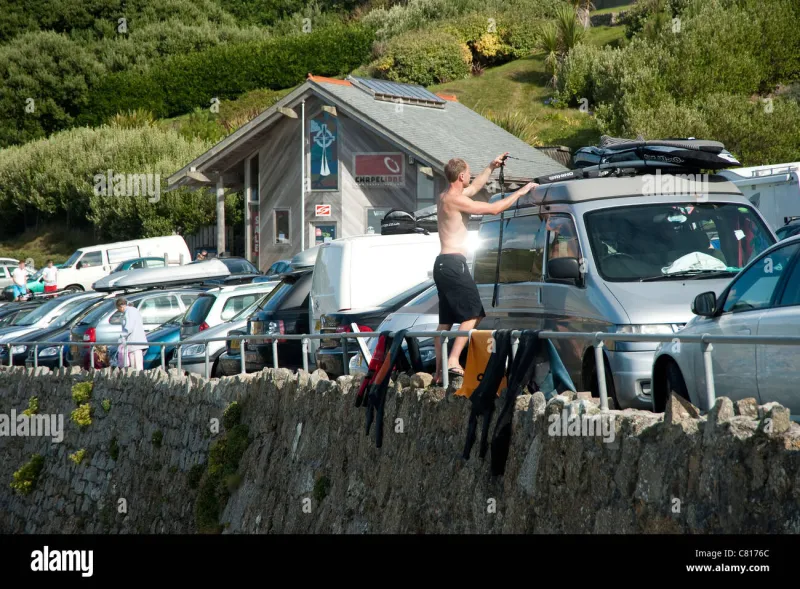
Photo: surfers loading boards into car driving to Cornwall, via c8.alamy.com
It's a Thursday evening in late October. Somewhere on the A30, a car full of surfboards and sleeping bags is pushing west into the dark. The occupants — four blokes in their late thirties, all with jobs and mortgages and at least one child between them — have been planning this trip since August. They've checked the swell forecast obsessively for a fortnight. They've argued about which boards to bring. They've split the fuel costs in a WhatsApp thread that now runs to several hundred messages.
They are not unusual. Not in Polzeath's world, anyway.
Ask around the car park above the beach on any given autumn weekend and you'll find registration plates from Yorkshire, Hertfordshire, the West Midlands, Greater Manchester. People who've driven three, four, five hours for a beach that's — objectively — a long way from most of where Britain actually lives. The question of why they keep doing it is more interesting than it might first appear.
The Logistics of Devotion
Let's start with the practicalities, because they're genuinely significant. A return drive from Leeds to Polzeath is comfortably over 600 miles. At current fuel prices, that's a meaningful outlay before you've paid for accommodation, food, or a single surf lesson. Factor in a long weekend stay during peak season and you're looking at a trip that costs serious money by any reasonable measure.
And yet it happens, repeatedly, with a commitment that borders on the compulsive. Regulars talk about annual or even monthly trips as though they're simply non-negotiable entries in the diary — like dental appointments, but considerably more enjoyable. "I've been coming down at least three times a year for the past eight years," says Marcus, 42, who lives outside Sheffield. "My wife thinks I'm slightly unhinged. She's probably right. But I've also never missed a trip."
The social infrastructure that enables this is worth examining. Many of the most committed long-distance Polzeath regulars travel in groups — friends who've been making the journey together for years, whose surf trips have become a kind of annual ritual that now feels load-bearing to the friendship itself. The car journey becomes part of the experience. The shared planning, the group chat, the collective anticipation — these are not incidental to the trip, they're woven into its value.
What Polzeath Has That Other Beaches Don't
Britain is not short of surf beaches. Newquay is more accessible from most of England. Croyde is closer for people in the South West. There are perfectly decent waves in Wales, in Scotland, on the North Sea coast if you're committed enough. So why Polzeath, specifically?
The answers you get are varied but they tend to cluster around a few consistent themes. The beach itself — its shape, its orientation, the way it handles different swells — gets mentioned a lot. Polzeath faces northwest and catches Atlantic groundswell in a way that more sheltered beaches simply don't. The waves are forgiving enough for improvers but interesting enough for people who've been surfing for years. "It's not the most challenging break in Cornwall," admits Jamie, 35, a regular from the Midlands. "But it's one of the most consistently good. You drive all that way and you're not gambling. You pretty much know you're going to get waves."
But the beach is only part of it. Regulars talk about Polzeath the village with a warmth that suggests something beyond mere geography. The pub. The familiar faces. The particular quality of light on the estuary at low tide. The sense that despite everything — the rising prices, the tourist season, the second-home saturation — there's still something genuine here. "It feels like it has a soul," says Marcus. "Lots of surf spots don't, honestly. Polzeath still does."
The Psychology of the Regular
There's a concept in environmental psychology sometimes called "place attachment" — the emotional bonds people form with specific locations. It's been studied in the context of everything from childhood homes to urban neighbourhoods, and it turns out to be surprisingly powerful. Places that feature in significant memories, in recurring rituals, in relationships that matter — these locations acquire a kind of emotional weight that's hard to shift and harder to replace.
Polzeath, for its regulars, operates exactly this way. The beach isn't just a beach; it's the place where someone learned to surf properly for the first time, or caught the best wave of their life, or had a conversation with a friend that they still think about. "My dad brought me here when I was twelve," says Claire, 39, who drives down from Cheshire several times a year. "I've been coming back ever since. It's not rational. It's just mine, somehow."
This emotional geography — the way certain places become anchored to identity and memory in ways that resist easy explanation — goes a long way toward explaining why petrol costs and travel time don't really enter the calculation in the way you might expect. You're not just buying a surf trip. You're maintaining a relationship with a place.
The Financial Reality, Honestly
None of this is to romanticise the economics out of existence. Long-distance Polzeath regulars are, almost without exception, aware that their habit is expensive. Most have developed strategies to manage it: travelling in groups to split costs, booking accommodation well in advance to get better rates, timing trips around shoulder-season pricing, staying in smaller and more affordable spots rather than the larger holiday lets.
Some have started treating Polzeath as a genuine second home in all but legal terms — building relationships with local accommodation providers, returning to the same places year after year, knowing which local spots to eat and which to avoid. The trip becomes more efficient over time, even as the attachment deepens.
"I've worked out that if I book early and travel with two other people, the whole long weekend costs me about what I'd spend on a decent city break," says Jamie. "And I'd rather be in the water at Polzeath than in a hotel in Barcelona, honestly. No offence to Barcelona."
None taken. The Atlantic doesn't give refunds, but it does give waves — and for a certain kind of person, that's more than enough to justify the drive.