The Red and Yellow Rules: A Lifeguard's Honest Guide to a Safer Polzeath Day
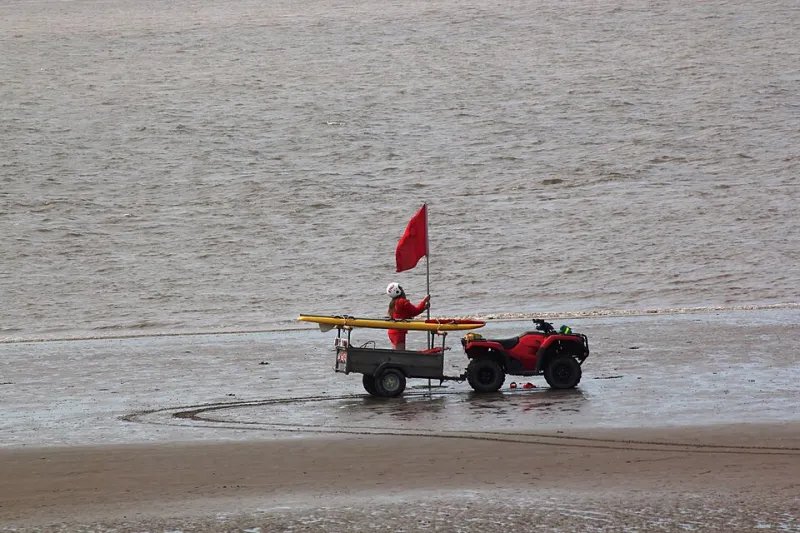
Photo: Geof Sheppard, CC BY-SA 4.0, via Wikimedia Commons
Polzeath on a bright afternoon looks almost foolproof. The sand is wide, the waves are friendly, and half the beach seems to be carrying a board. That is exactly why the lifeguards spend so much of their day repeating the same handful of things. Not because visitors are reckless, but because the sea does not come with labels.
Ask anyone who has spent a season in the red-and-yellow hut and they will tell you the same story. The serious incidents are rarely dramatic. They are usually a family who set up in the wrong spot, a swimmer who mistook confidence for safety, or a child who wandered 50 metres while everyone was watching the waves.
The sea is not being dramatic
Rip currents are the classic beach myth. They do not pull you under; they pull you out. At Polzeath, they tend to form in the gaps between sandbanks and around the edges of the main channel, and they are often strongest as the tide turns. A lifeguard can spot one from the hut in seconds. From waist-deep water, it just looks like a slightly darker patch with fewer people in it.
If you feel yourself being taken out, the advice is boring and correct: do not fight it. Swim parallel to the beach until you are out of the flow, then head in. If you cannot make progress, stay calm, float, and raise one arm. A waving hand is easier to spot than a shouting mouth.
Flags are a map, not decoration
The red-and-yellow flags mark the patrolled area. That is where the lifeguards can see you and reach you quickly. The red flag means no swimming, full stop. The black-and-white chequered flag is for surfboards and kayaks, not bodies. If you are swimming with a bodyboard and the flags say otherwise, you are in the wrong lane.
One patrol member put it neatly: 'People think the flags are about rules. They are really about lines of sight.' A lifeguard on the beach can only watch so much water. Between the flags, they are watching you. Outside them, you are on your own.
Board choice matters more than you think
A soft-top is not a beginner's toy; it is a sensible choice for most holiday surfers. It is forgiving, it floats, and it hurts less when it hits someone. A hard board is faster and sharper. If you are hiring, be honest about your ability. The person behind the counter is not judging you; they are trying to send you out with the right equipment.
Check your leash before you paddle out. Check your fins before you carry the board through a crowd. And never use a bodyboard as a flotation aid for a non-swimmer. It is not a lifebuoy, and it will not behave like one.
The tide is faster than your picnic
Polzeath has a big tidal range, and the water can cover the lower beach quickly. The classic mistake is setting up below the high-water line on a falling tide, then wandering off for a surf or a pasty. When you come back, your bag is either surrounded by water or gone.
Keep your kit high and dry, and look at the tide times before you claim your spot. If you are unsure, ask a lifeguard where the water is likely to reach. They will not mind. They would much rather answer that question at 10am than help you rescue a rucksack at 3pm.
Lost children are a team effort
Every parent thinks they will keep an eye on their child. Every lifeguard has seen a parent turn around for 30 seconds and lose sight of one. The beach is busy, the light is bright, and small people are quick.
Agree a meeting point before you put the towels down. Write your mobile number on your child's wrist if they are old enough to understand. If you lose sight of them, tell a lifeguard immediately. Do not spend 20 minutes searching on your own first. The sooner the team knows, the sooner they can scan the water, the sand, and the slipway.
A confident swimmer is not always a safe one
Pool lengths do not prepare you for cold water, currents, and a board coming at your head. A strong swimmer can still panic when the temperature drops and the bottom disappears. That is not a character flaw; it is physiology.
Know your limits. Swim with someone. Get out before you are tired. If you are cold, get dry. If you are unsure, stay between the flags and ask.
The lifeguards at Polzeath are not there to spoil the fun. They are there so the fun does not turn into a story you tell with a shaky voice later. Respect the flags, watch the water, and the beach will look after you.